On a windswept plateau southwest of Sartène, time seems to stand still among 6000-year-old stones. Cauria, one of Corsica’s most important prehistoric sites, is home to the island’s best-preserved flat-topped dolmen and a collection of enigmatic carved menhirs.
The monuments can be explored via an easy walking trail that takes about an hour to complete. Far less visited than the famous Filitosa, Cauria provides a quieter and more authentic experience, revealing a fascinating chapter of Corsica’s ancient past.
The site is set in a remote and peaceful landscape that was once inhabited by a civilisation whose history and traditions remain only partly understood. As you follow the path, contemplate the mystery of these old stone structures- their purpose, the people who built them, and the stories they hold.
This page contains affiliate links meaning I get a commission if you decide to make a purchase through my links, at no extra cost to you. Click here to learn more.
CORSICA’S PREHISTORIC PAST
The prehistoric sites of southern Corsica show a story of two civilisations, one following the other. The earlier population, present from at least the 5th millennium BC, left behind menhirs, alignments, and dolmens visible today at Cauria, Palaggiu, and Filitosa.
Around 1200 BC, the Torréens arrived from the eastern Mediterranean and gradually absorbed the older culture, constructing the distinctive circular stone towers whose traces survive at Filitosa, Cucuruzzu, and Capula. At Filitosa, the transition between the two civilisations is especially visible- the Torréens smashed many earlier menhirs and reused the fragments in their tower walls. Together, they form one of the most complete prehistoric landscapes in the Mediterranean.
QUICK FACTS
- The Cauria Prehistoric Site is located 14 km south of Sartène, on the road to Tizzano.
- It comprises three megalithic complexes (Alignement de Stantari, Alignement de Rinaghju, and Dolmen de Fontanaccia), spread across a windswept 60-hectare plateau.
- Entry is free, and the site is open to visitors year-round.
- The 2.7-kilometre walking trail takes approximately 1 hour to complete.
- Shade is limited along the route, so bring a hat, sunscreen, and water, especially during warmer months.
- The trail is family-friendly, with a mostly flat, wide path that is easy to follow and free from significant obstacles. However, it’s not suitable for pushchairs and strollers.
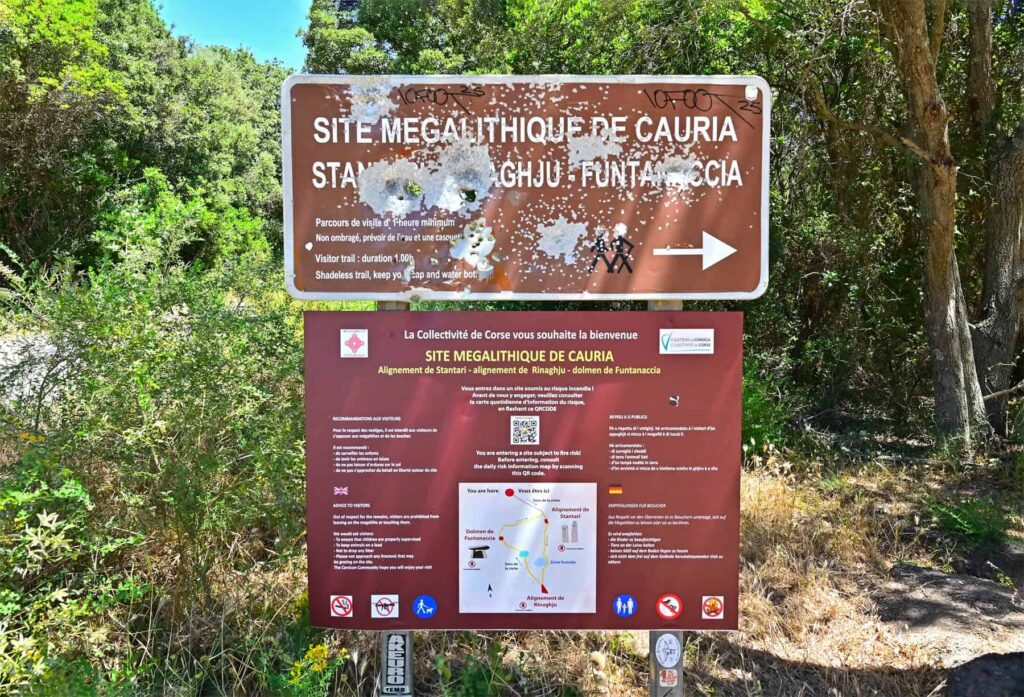
IMPORTANT TIP – In summer, when wildfire risk is high, scan the QR code on the information panel at the site entrance to check the daily fire risk map before your visit.
GETTING THERE
To reach the Cauria site from Sartène, follow the T40 southwest for 2.5 km. At Bocca Albitrina, turn right onto the D48 towards Tizzano. After 7.5 km, turn left following the signs for Cauria and continue for the final 4.6 km along the D48A. Although the road surface has been recently renewed and is in good condition, the route is narrow, so drive carefully and be prepared for oncoming traffic.
NEAREST VILLAGE FOR FOOD AND DRINK – The Cauria site has no facilities, so plan ahead. The nearest place is the coastal village of Tizzano, about 10 km further along the D48, with a couple of restaurants and a beautiful beach.
PARKING
Park in the shaded lay-by on the left-hand side of the road. The site remains quiet even in summer, but arriving early will help ensure you have a parking space and avoid the strongest midday sun. The track opposite the parking area leads directly to the monuments.
At the entrance, take a moment to consult the information panel, which outlines the route and the three main points of interest. If you are visiting with a dog, keep your pet on a lead.
USEFUL TIP – Apart from the entrance information panel, all signage at Cauria is in French. When I need to translate foreign text, I use my iPhone camera and tap the on-screen text icon.
THE ROUTE
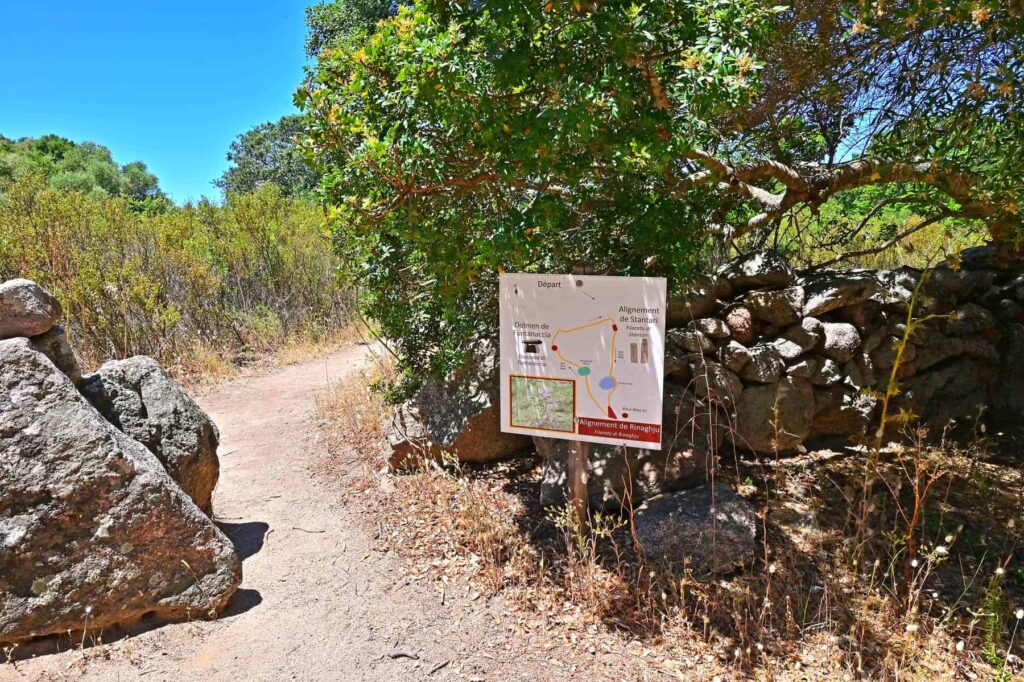
The route is a 2.7 km loop across mostly exposed terrain, with occasional shaded sections where you can take a break from the sun. It crosses a beautiful plateau with views over fields, green vineyards, and distant mountains, while the imposing Punta di Cauria rises nearby in a granitic outcrop.
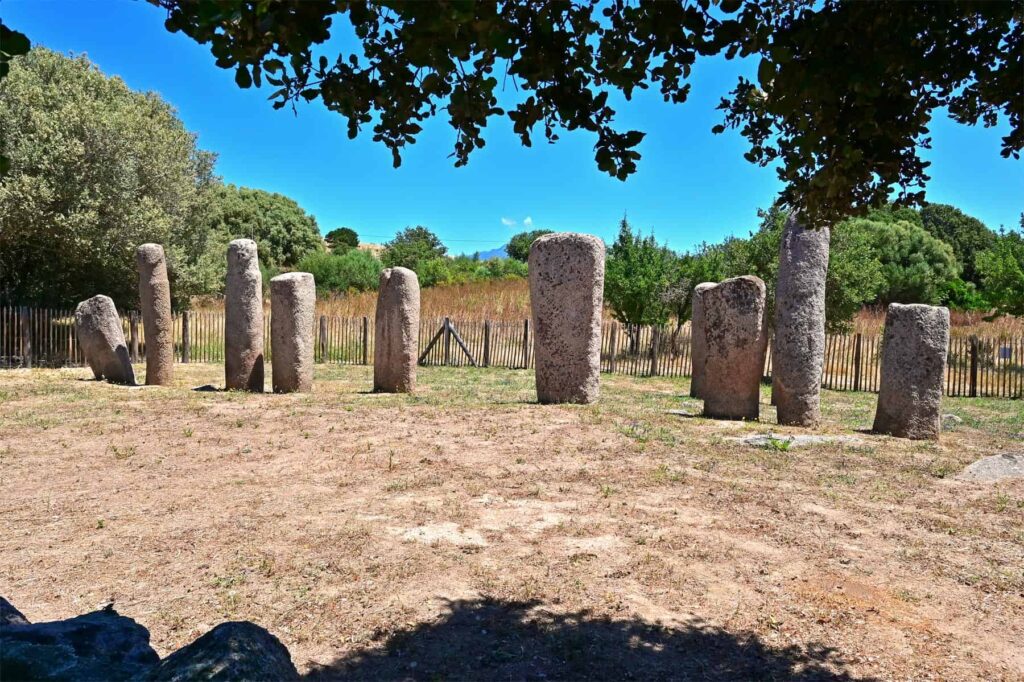
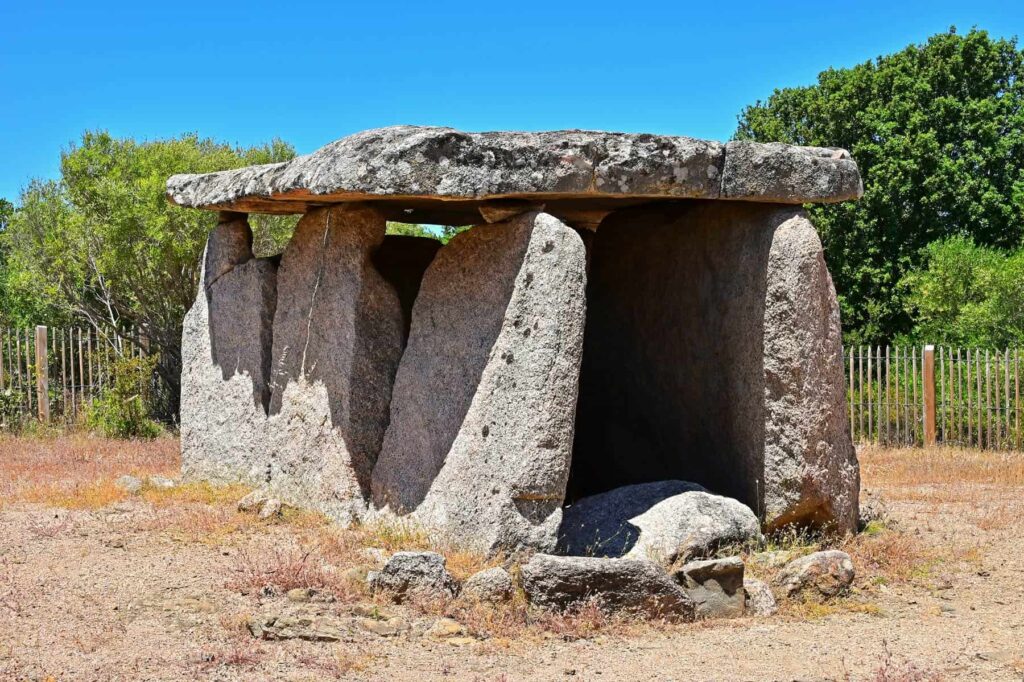
You begin your walk at the Alignement de Stantari and its 11 menhirs, before continuing to the shaded area of Rinaghju. The visit concludes at the Dolmen de la Funtanaccia, a superb ancient tomb built from six massive stone blocks.
The suggested loop continues back via I Stantari (indicated by the white arrow on the ground), but at the crossroads past Rinaghju, I take the left turn for the quickest route back to the car park.
PRACTICAL TIP – I recommend wearing covered footwear. Several sections of the trail cross loose, sandy ground, which can easily find its way into open shoes.
ALIGNEMENT DE STANTARI
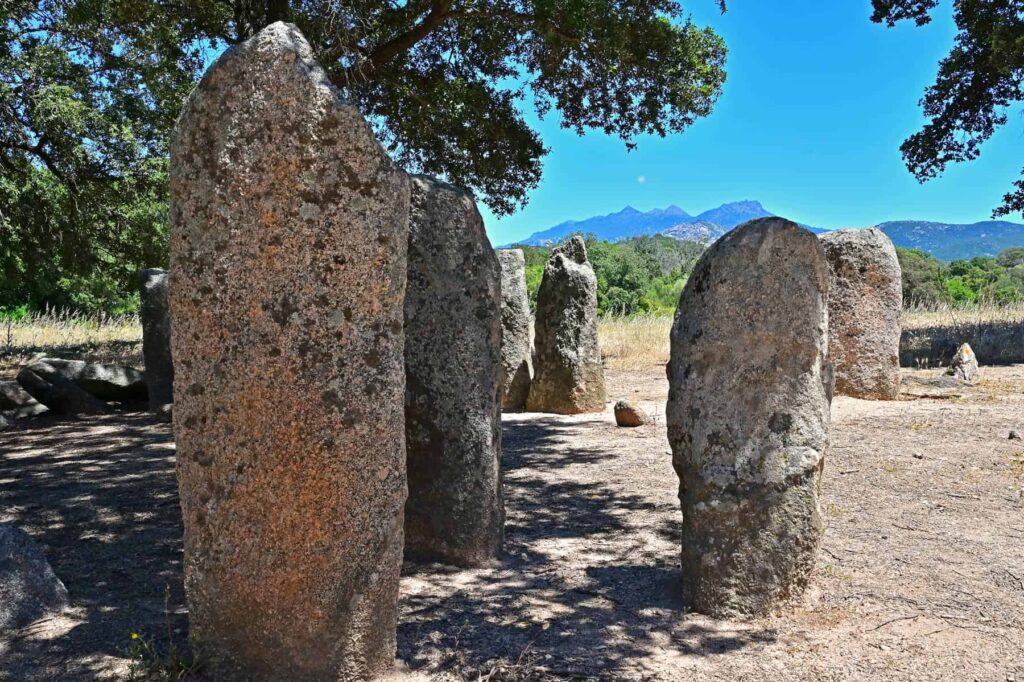
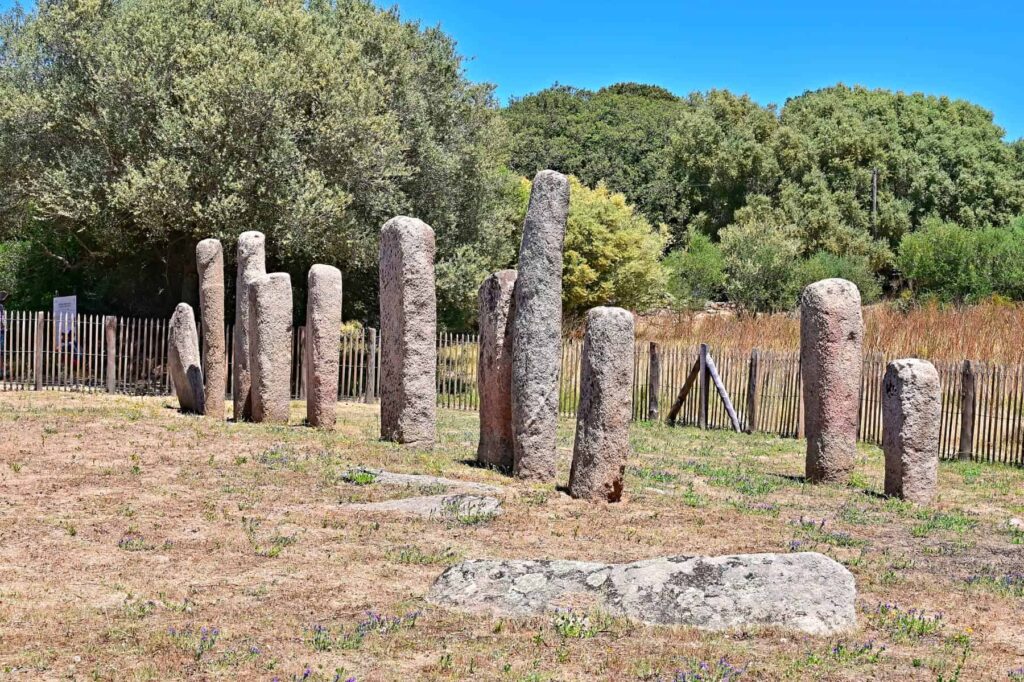
The first complex you will encounter along the route is called Alignement de Stantari, considered the most impressive of Cauria’s prehistoric monuments. Dating back to the mid-Neolithic (4500-4100 BC) and Bronze Age, it consists of 55 monoliths in total, though many remain buried or lying flat. Archaeologist Roger Grosjean excavated and re-erected 22 of them in the 1960s, including 7 carved statue-menhirs depicting human figures armed with long swords.
Today, 11 stones remain standing, arranged in two parallel rows, giving visitors a clearer impression of their original appearance. Researchers believe they may once have been painted with red ochre. I Stantari was designated a Historic Monument in 1975, together with the neighbouring Rinaghju alignment.
ALIGNEMENT DE RINAGHJU
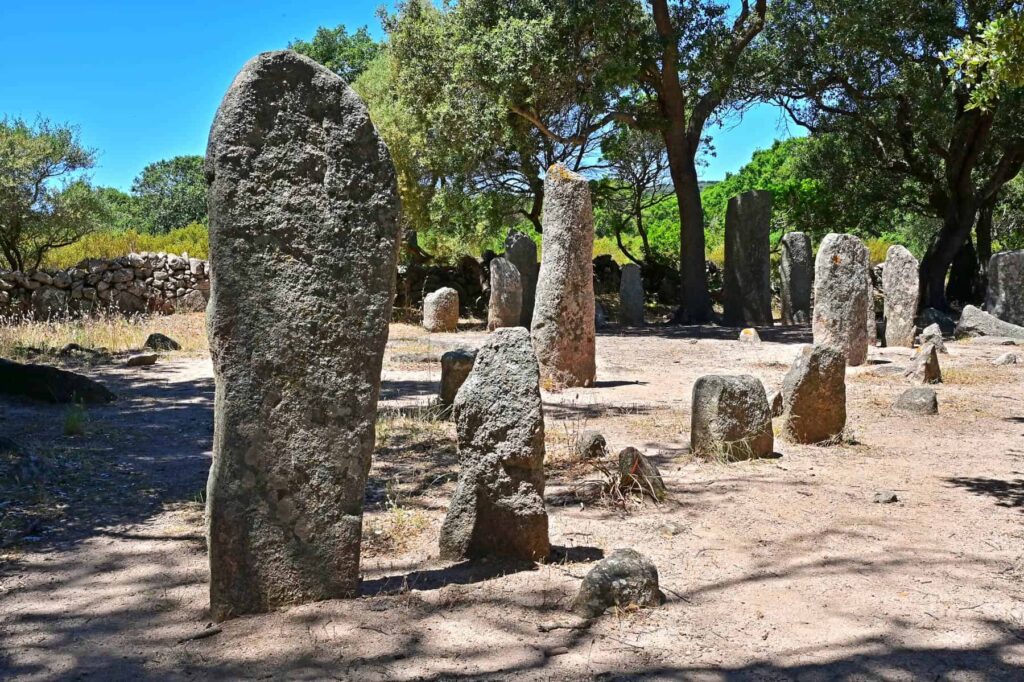
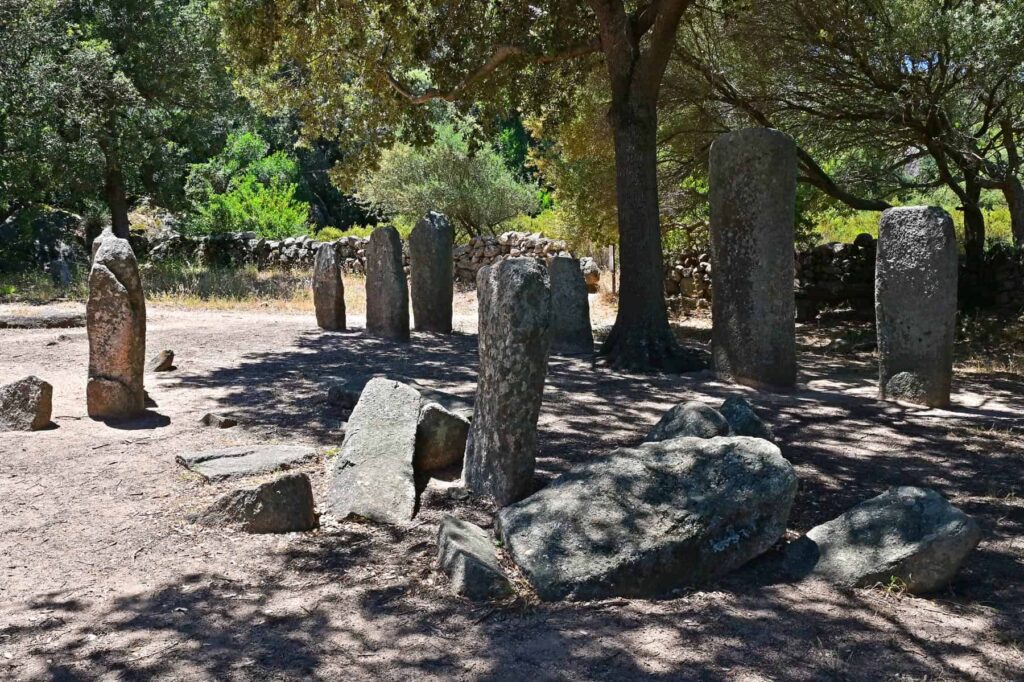
A few hundred meters further, shaded by trees, is Rinaghju- one of the oldest and most fascinating parts of the Cauria prehistoric site. Archaeological evidence shows that people lived here as early as 5700 BC, making it one of Corsica’s earliest known settlements. Excavations uncovered traces of dwellings, hearths, pottery and stone tools linked to the Neolithic Cardial culture, which spread across Corsica, Sardinia and parts of mainland Italy.
Today, you can view dozens of granite menhirs arranged in several alignments, the result of successive phases of construction spanning thousands of years. Some of the tallest stones reach over 3 metres in height. Among them stands Rinaghju I, a rare statue-menhir engraved with the image of a warrior carrying a sword, although the carving has been softened by centuries of weathering.
DOLMEN DE FONTANACCIA
Cauria’s third point of interest, Dolmen de Funtanaccia, is considered the finest and best-preserved dolmen in Corsica. First documented in 1840 by Prosper Mérimée, it is built from large granite slabs and topped by an large capstone, standing on a small rise. The structure weighs more than 15 tonnes, making it an impressive feat of prehistoric engineering. The tomb chamber, measuring 2.6 meters in length, remains remarkably intact despite the passage of thousands of years. Excavations have revealed no surviving burial remains.
Named the ‘Devil’s Forge’ in the 19th century, the dolmen has been protected as a Historic Monument since 1889.
INTERESTING FACT – Much of what we know about Corsican prehistory is owed to Roger Grosjean, a French CNRS researcher who dedicated two decades from the 1950s onwards to excavating and documenting the island’s prehistoric sites- Filitosa, Cauria, and Palaggiu. Thanks to his work, they are now recognised, protected, and made accessible to the public.
OTHER PREHISTORIC SITES WORTH VISITING
- ALIGNEMENT DE PALAGGIU – One of the largest megalithic alignments in Corsica, Palaggiu features 258 menhirs, including three carved statues, scattered across the maquis 9 kilometres northwest of Cauria. Despite being less structured, the site’s scale and raw setting make it particularly atmospheric, especially at sunset.
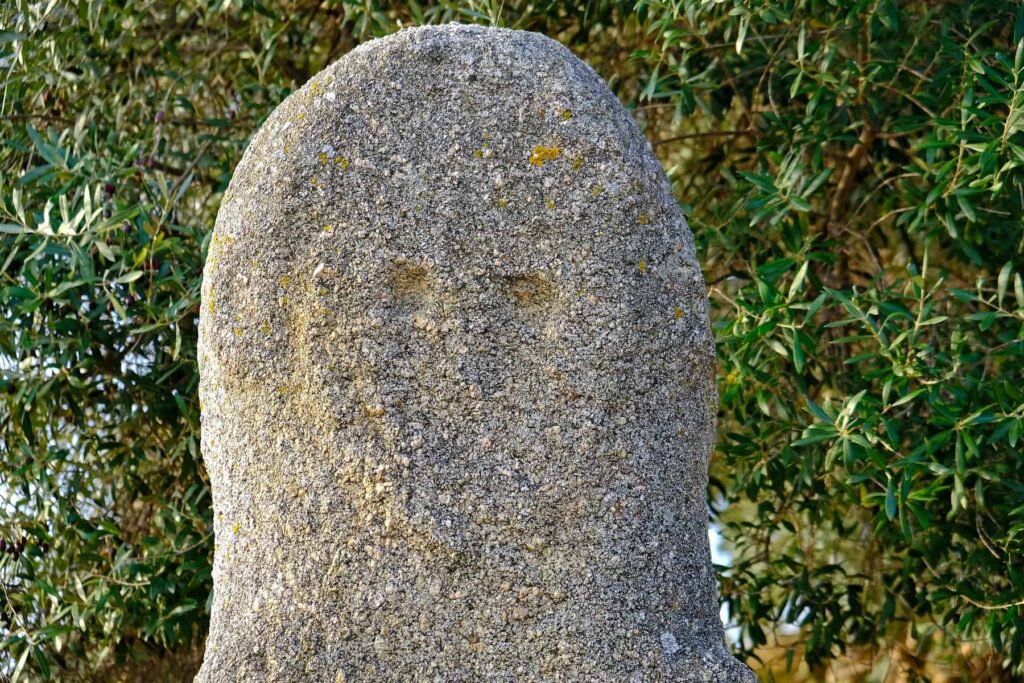
- FILITOSA – Included in my list of Corsica’s most beautiful places to visit, Filitosa is the island’s most famous archaeological site and one of the most significant prehistoric complexes in Europe. It is best known for its carved statue-menhirs, some depicting human faces and weapons, as well as traces of ancient settlements. Well-maintained pathways winding among olive trees and clear signage make it an accessible introduction to Corsica’s megalithic heritage.
- CUCURUZZU AND CAPULA – A remarkable archaeological site perched atop a granite outcrop in South Corsica’s Alta Rocca mountains. Cucuruzzu features well-preserved remains of a Bronze Age tower built around 1400 BC by the Torréan civilisation, while Capula, just a short walk away, has a medieval castle constructed directly on top of much older foundations- a quiet, off-the-beaten-path place.
BOOK A BOAT TRIP FROM PROPRIANO
Enjoy a boat excursion to the Gulf of Valinco. Discover the region’s most beautiful seascapes on a 2-hour boat tour with an aperitif and a snorkelling break. Choose from a morning, afternoon, or sunset tour departing from Propriano.
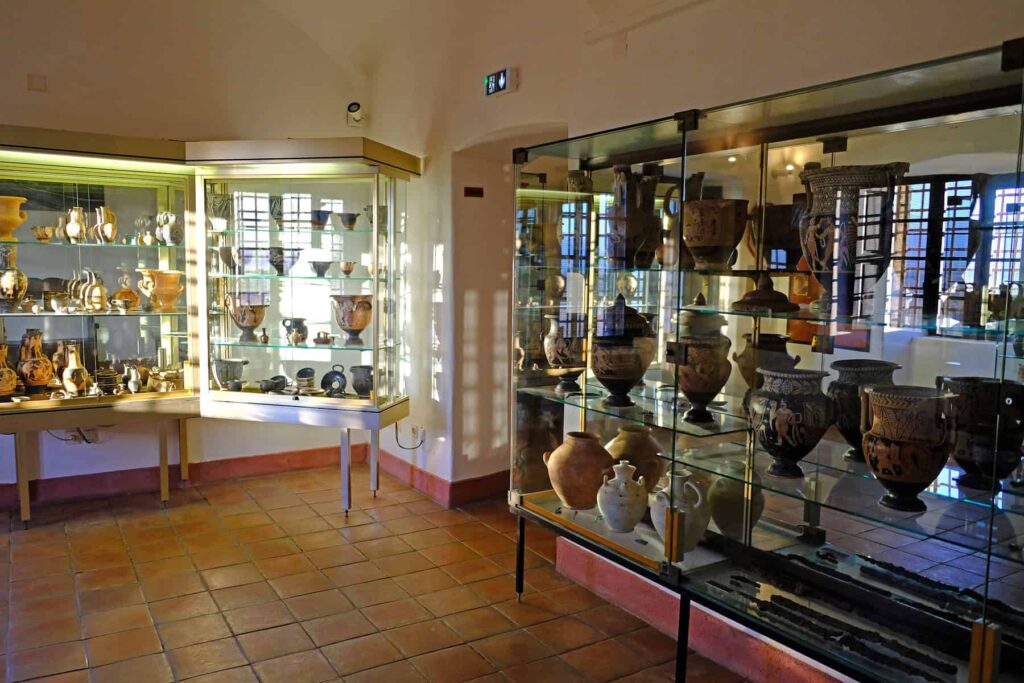
MUSEUMS OF ANCIENT CORSICA
- MUSÉE DE PRÉHISTOIRE ET D’ARCHÉOLOGIE DE SARTÈNE – Complement your Cauria site walk with a visit to the Departmental Museum of Corsican Prehistory and Archaeology in Sartène, which features full-sized replica granite menhirs with clear explanations of the cultures that created them. Its collections cover nearly 10000 years of human settlement from the earliest known populations to the end of the Genoese era in the 15th century. They include weapons, jewellery, vases, and shipwreck objects.
- MUSÉE DE PRÉHISTOIRE ET D’ARCHÉOLOGIE D’ALERIA – Aleria, dating back to the early Iron Age in the 6th century BC, is the oldest city in Corsica. It was successively occupied by the Greeks, Carthaginians, and Romans. Its open-air archaeological site contains a pre-Roman necropolis with over 200 tombs alongside Roman ruins, including a forum and temple. All the excavated finds- ceramics, weapons, coins, and Etruscan objects- are displayed in the Jérome Carcopino Archaeology Museum, set inside a 14th-century Genoese fort overlooking the complex.
- MUSÉE DE L’ALTA ROCCA – A smaller but highly worthwhile museum located in Lévie, within the mountains of southern Corsica. It presents artefacts of human activity from prehistory, with special focus on the Neolithic and Bronze Age, to the modern rural world, providing excellent context for inland sites like Filitosa and Cauria. It holds a noteworthy highlight- the Lady of Bonifacio, the oldest human remains ever discovered in Corsica.
BOOK A CANYONING ADVENTURE
Climb, jump, rappel, and swim your way through the Baracci Canyon near Propriano on a canyoning tour designed for beginners. Ideal for families, this fun activity is suitable for children 7 years old and above, able to swim.
OTHER ATTRACTIONS IN THE REGION
- Try local wines renowned for their excellent quality and expressive indigenous grape varieties. Domaine Saparale is my favourite estate here, and its rosé is perfect to accompany a summer barbecue.
- Explore Sartène, often described as the most Corsican of all towns on the island.
- Enjoy a freshwater adventure in the Baracci Canyon- join a canyoning excursion down the river for an unforgettable experience in wild scenery.
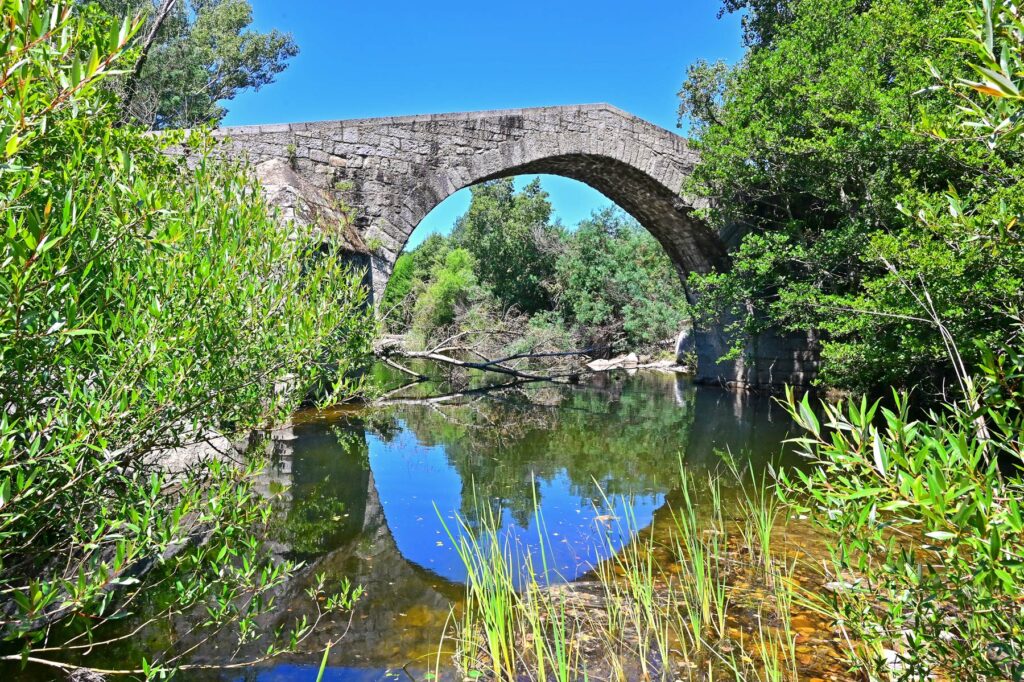
- Stop at the blissful spot marked by Spina Cavallo, a picture-perfect Genoese bridge that spans Rizzanese River.
- Relax in Propriano, the most popular seaside resort in the area, with its waterfront restaurants, lively marina, and sandy beaches.
- Hike along the coastal trail from Tizzano to Campomoro, winding through stunning coves and fragrant maquis.
- Discover Plage de Roccapina, a true beach paradise with some of the clearest waters in Corsica lapping against delicate white sand.
- Unwind on the secluded beaches along the Pianottoli-Caldarello coastline, away from the crowds. Choose Plage de Chevano for particularly clear waters and golden sand.
- Visit Bonifacio, the island’s top attraction- a medieval gem perched on towering white cliffs, with views across to Sardinia.
TRAVELLER’S COMPANION FOR A TRIP TO CORSICA – GRAB YOUR EBOOK!
33 Natural Pools and Waterfalls in Corsica
Descriptions – Directions – Coordinates
YOU MAY ALSO LIKE
- Top 11 most beautiful places in Corsica – the ultimate bucket list
- 15 Stunning Bonifacio beaches you can’t miss
- 15 Hidden gems in Corsica – discover the island’s best-kept secrets
- Porto Vecchio travel guide – everything you need to know
- Best things to do in Ajaccio – the complete guide
- Roccapina – beach lovers’ dream
- 11 Charming Corsican villages that will steal your heart
- Bonifacio travel guide – discover Corsica’s top destination
- Iles Lavezzi – escape to paradise in Corsica
- Where to stay in Corsica – best places and areas for your visit
- Best places to stay in Corsica for couples
- Corsica – where to go and what to do
- Ferries to Corsica – practical guide to booking your crossing with Corsica Ferries
- Visiting Corsica – how to get there
- Is Corsica an expensive travel destination – money guide for visitors
- Getting around Corsica – do you need a car?
- Is Corsica a safe place to visit – travel advice and tips
- What to avoid in Corsica – 11 common mistakes
PLANNING A TRIP TO CORSICA? CHECK OUT THESE RESOURCES!